
New York Knicks – Madison Square Garden
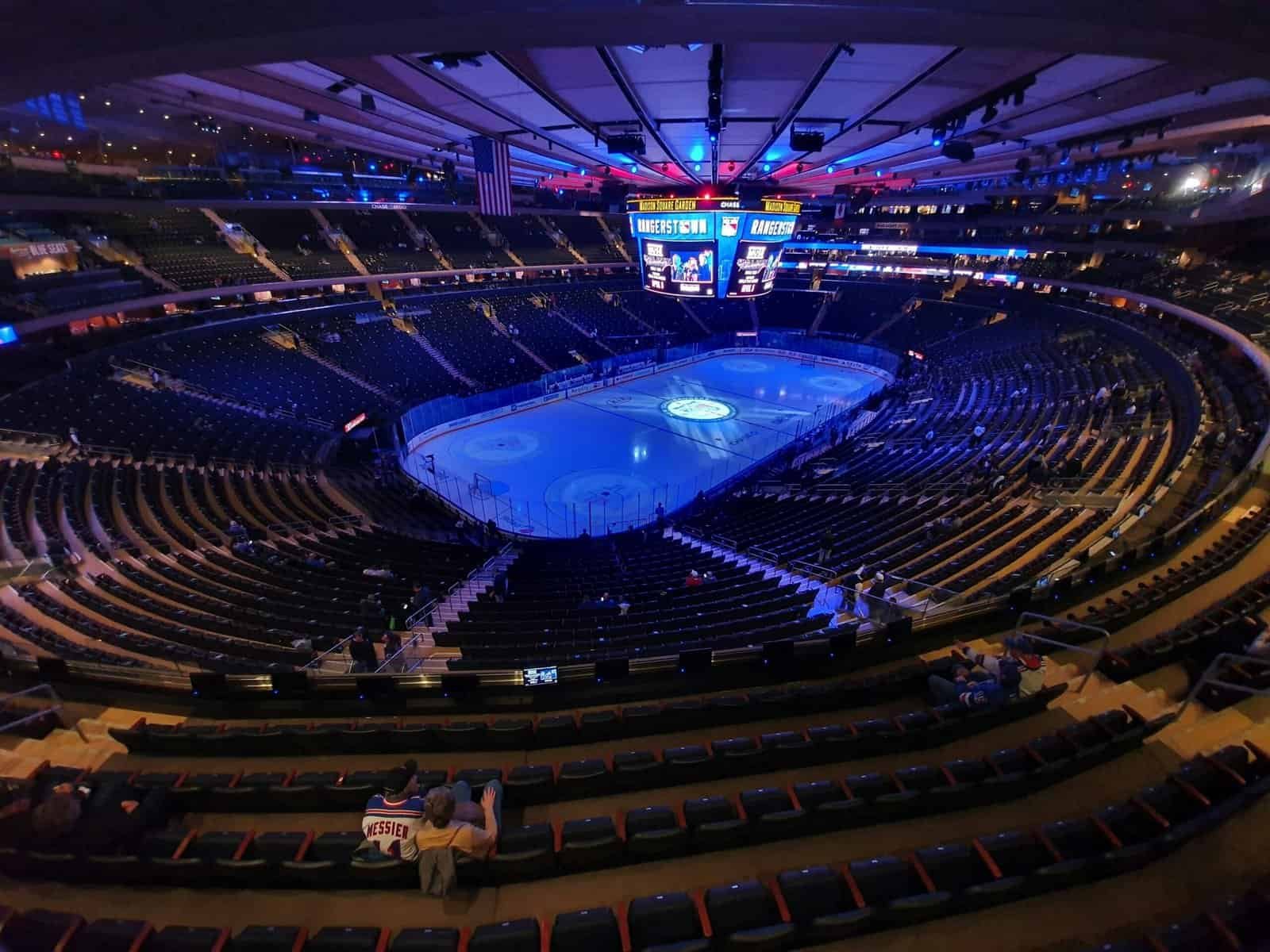
Madison Square Garden does not sit beside New York so much as on top of it. Beneath the floor where the Knicks play, trains run all night through Pennsylvania Station, the busiest rail hub in the Western Hemisphere. No other major arena in world sport is stacked directly onto a transport system like this, and nothing explains the building’s character better. It is compact, vertical and startlingly loud, because it was never given the room to sprawl.
Ask a sports fan anywhere to name one venue and a great many will name this one. The New York Knicks Madison Square Garden pairing is among the very few in sport where the team and the building are spoken of in the same breath — where the address carries as much weight as the roster, and where a visiting player’s career is measured, at least a little, by what he did here.
The building that replaced a masterpiece
The Garden that stands today is the fourth to carry the name, and it opened in February 1968. Its construction came at a famous cost: the original Pennsylvania Station, a vaulted 1910 landmark by McKim, Mead & White, was torn down to make space for it. The demolition provoked such public fury that it helped produce New York’s Landmarks Preservation Law in 1965 — one of the rare cases where a building’s destruction permanently changed how a city protects everything else.
What replaced it is not beautiful in any conventional sense. It is a drum — a circular arena between 31st and 33rd Streets on Seventh Avenue, roofed by a system of cables rather than columns, which is precisely why there is not a supporting pillar in the sightlines. The architecture is unloved and the engineering is quietly brilliant, and the combination is very New York.
Two championships, and the walk that defined them
The Knicks have won two NBA championships, in 1970 and 1973, and both belong to Red Holzman’s team of passers and defenders. The first produced one of the most replayed moments in American sport. Willis Reed, the captain, had torn a muscle in his thigh and was not expected to play Game 7 against the Los Angeles Lakers. He emerged from the tunnel before tip-off, scored the game’s first two baskets, and contributed almost nothing else — while Walt Frazier quietly produced 36 points and 19 assists and won the game outright.
That night set the terms the building has been held to ever since. The Garden’s reputation is not really built on trophies, of which there are fewer than the city’s self-image suggests; it is built on nights like that one. Anyone reading the franchise’s full arc from expansion team to institution finds the same pattern — long stretches of frustration punctuated by moments the rest of the league never forgets.
The Ewing years and the long wait
The 1990s gave the Garden its most sustained era of contention and none of the reward. Patrick Ewing’s Knicks were physical, defensive and relentlessly close: a Finals defeat to Houston in 1994 decided by a handful of possessions, and an improbable run to the Finals in 1999 as an eighth seed. They did not win. What they did instead was fix the arena’s modern identity as a place where opponents are made uncomfortable — a reputation the team has spent the years since either living up to or apologising for.
The drought that followed was long enough to become part of the folklore. Its ending has been the more interesting story of the current era, and the recent deep postseason runs have restored something the building had been missing for two decades: the sense that a night here might matter beyond the standings.
What it is like inside
The first thing that surprises visitors is the pitch. Because the Garden was built upward rather than outward, the upper tier rises at an angle that feels almost theatrical, and the seats commonly called the blue seats sit far above the floor but remarkably close to it in horizontal terms. The acoustics follow from the geometry: sound has nowhere to escape, and a Garden crowd at full volume is an enclosed, physical thing rather than a distant roar.
A major renovation completed in 2013 added the two suspended skybridges that run above the court — a genuinely unusual piece of design, putting spectators in the air over live play. At floor level sits Celebrity Row, where the courtside regulars, Spike Lee foremost among them, have become part of the broadcast furniture. Capacity for basketball sits just under 20,000, which is unremarkable by modern standards; the intensity is not a function of size.
Beyond basketball
The Knicks share the building with the New York Rangers, and the Garden’s claim to be the world’s most famous arena rests as much on what happens when neither is playing. It staged the Ali–Frazier fight of March 1971, still the most heavily freighted night in boxing’s history, when two undefeated heavyweight champions met with the title and a great deal else at stake. It has hosted Billy Joel’s long-running residency, a monthly fixture that turned a concert booking into a civic habit. Few venues carry three distinct cultural histories at once; this one does.
Visiting the Garden
Access is the easiest of any arena in North America, for the same reason the building is shaped as it is: you arrive by train, directly underneath. Penn Station places the concourse a single escalator ride away, and the surrounding subway lines make a car unnecessary and unwise. Doors typically open well before tip-off, and the pre-game hour is worth taking — the concourse memorabilia is genuinely good, and the building empties out onto Seventh Avenue afterwards in a way that rewards not rushing.
If you are planning a trip around a fixture rather than the other way round, the shape of the calendar matters more than the opponent: our season preview sets out where the meaningful dates fall, and the viewing guide covers what to do when you cannot be in the room.
The Garden is not the largest arena in basketball, nor the newest, nor the most comfortable. It is the one that visiting players talk about afterwards. That is a harder thing to build than a roof, and it is why an ordinary Tuesday here still feels like an occasion — something we keep tracking across the league in our basketball coverage.