Why the Winter Olympics Matter – History, Legacy, and the Global Stage
Every four years, the world turns its attention to snow and ice. The Winter Olympics stand apart in the global sports calendar, and to grasp why the Winter Olympics matter, we need to look at what makes winter sports fundamentally different from their summer counterparts.
The Scarcity Factor
Unlike football’s World Cup or athletics’ Summer Olympics, winter sports require three things most of the world doesn’t have: specialized venues, specific climate conditions, and technical expertise built over generations.
Only 16 nations have ever won a Winter Olympics medal. Compare that to the Summer Olympics, where over 150 countries have medaled. The geographic concentration is stark: if you don’t have mountains, consistent snowfall, or the infrastructure to create artificial snow and ice at elite level, your country simply cannot compete.
This scarcity explains why the Winter Olympics matter: they are the ONLY truly global platform where these sports receive worldwide attention. There’s no lucrative professional league for biathlon. No billion-dollar broadcast deals for luge. Cross-country skiing doesn’t fill stadiums year-round. For most winter sports, the Olympics represent the peak – the moment when casual fans tune in, when sponsorship money flows, and when athletes can convert years of training into real recognition and income.
The Four-Year Window
Summer Olympic sports mostly have robust professional circuits. Tennis players compete at four Grand Slams annually. Track athletes race Diamond League meets around the world. Basketball has the NBA, FIBA World Cup, continental championships.
Winter sports? Most athletes compete in World Cup circuits that the general public barely notices. Figure skaters perform for skating enthusiasts at ISU championships. Alpine skiers race down World Cup courses in European ski resorts for prize money that wouldn’t cover a professional footballer’s weekly wage.
The Olympics are different. The Olympics are when Mikaela Shiffrin becomes a household name, when Chloe Kim’s halfpipe run goes viral, when Lindsey Vonn’s comeback attempt makes global headlines. For winter athletes, this is often the ONLY moment in a four-year cycle – sometimes a career – when the world actually watches.
That creates pressure unlike anything in summer sports. A tennis player who fails at the Olympics can console themselves with Wimbledon next year. A ski jumper who underperforms in Olympic qualification might not get another chance until they’re 25 or 26 – past prime years in a sport that demands explosive power and fearlessness.
National Pride & Mountain Heritage
The Winter Olympics serve as a statement of winter sports prowess and mountain heritage that resonates differently than summer competition.
Norway – a nation of 5.5 million people – dominated the medal table at both PyeongChang 2018 (39 medals) and Beijing 2022 (37 medals). Their success in Nordic events reflects cultural identity: cross-country skiing isn’t just a sport in Norway, it’s a national pastime woven into education, military service, and recreational life.
Canada’s ice hockey obsession makes Olympic gold in that sport more culturally significant than any other achievement. Germany’s sliding sports tradition (bobsleigh, luge, skeleton) carries legacy from decades of engineering excellence and track design. Austria and Switzerland’s alpine skiing dominance connects directly to their mountain culture and ski resort economies.
For nations with winter sports tradition, Olympic success validates cultural identity in ways summer sports cannot replicate. And for nations without that tradition – watch how China invested billions to develop winter sports infrastructure for Beijing 2022, transforming from winter sports irrelevance to genuine medal contention in less than a decade when they hosted.
Italy’s Olympic Legacy
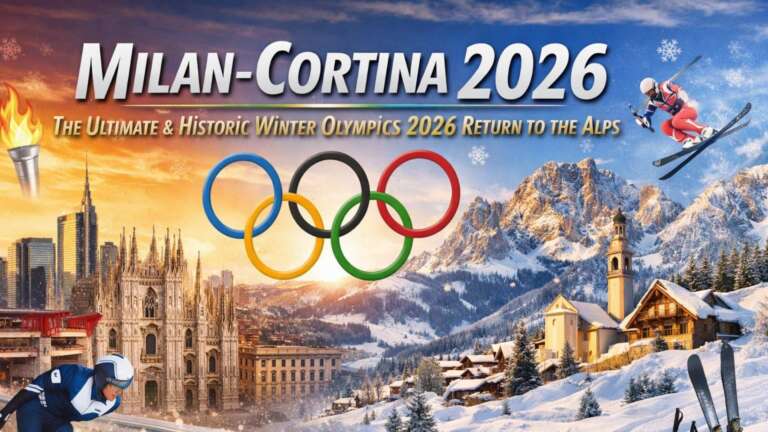
Milan-Cortina 2026 marks the third Winter Olympics hosted by Italy, and the fourth Olympics overall.
Rome hosted the Summer Olympics in 1960. Cortina d’Ampezzo held the 1956 Winter Games, establishing itself as a legendary alpine venue. Turin hosted the 2006 Winter Olympics, considered one of the most successful and well-organized Winter Games in history.
This experience shows. Italy knows how to stage major sporting events, how to balance elite competition with spectacular venues and cultural celebration. The decision to distribute Milan-Cortina 2026 across multiple regions – Milan for ice sports, Cortina and the mountain valleys for alpine and Nordic events – reflects hard lessons learned about sustainability, infrastructure reuse, and avoiding the “white elephant” problem where Olympic venues sit abandoned after the Games.
The Athletes’ Stories
Beyond medals and national pride, the Winter Olympics deliver human drama compressed into 90-second runs and two-minute performances.
Lindsey Vonn at 41, attempting a comeback after serious knee injuries that forced her retirement in 2019, racing against athletes half her age in the most dangerous sport at the Olympics. Even her crash in the final pre-Olympic race couldn’t stop her from competing in Milan-Cortina.
Ilia Malinin, the figure skating prodigy who landed the first-ever quadruple axel in competition, now attempting to convert technical mastery into Olympic gold while carrying American expectations in a sport where they haven’t won men’s gold since 2010.
Sidney Crosby, the Canadian ice hockey legend, getting perhaps his final shot at Olympic gold after NHL players missed PyeongChang 2018 and Beijing 2022 entirely.
Eileen Gu, the Chinese-American freestyle skier who chose to represent China, won two golds and a silver at Beijing 2022, and now faces the pressure of defending champion in a sport where progression is relentless and crashes are common.
These aren’t just athletic competitions – they’re life stories compressed into single moments where years of sacrifice either pay off spectacularly or end in heartbreak.
Why We Watch
The Winter Olympics remind us, in the purest way, why the Winter Olympics matter. Because someone has dedicated their entire existence to going faster, flying farther, spinning more times in the air, or hitting targets with a rifle after skiing at maximum heart rate. Because the margin between gold and fourth place can be one-hundredth of a second. And because athletes risk serious injury on every run for the chance to stand on a podium and hear their national anthem.
In an era of year-round professional sports saturation, the Winter Olympics remain special precisely because they’re rare. We watch because for 17 days every four years, the world remembers that there are still competitions that matter more than money, athletes who compete for glory rather than contracts, and sports where the Olympics represent the absolute peak of what’s possible on snow and ice.
Milan-Cortina 2026 continues that tradition. For the next 17 days, legends will be made, records will fall, and the next generation of winter sports stars will announce themselves to the world.
More about Milan-Cortina 2026
- Milan Cortina 2026 Schedule – Calendar of Key Events
- Visit the official 2026 Winter Olympics website here
Olympics, all about the summer and winter events here on WorldSportTalk
See also: Paris 2024 Summer Olympics