
Vikings Are Back. Historical Medieval Battle enters the “ring”
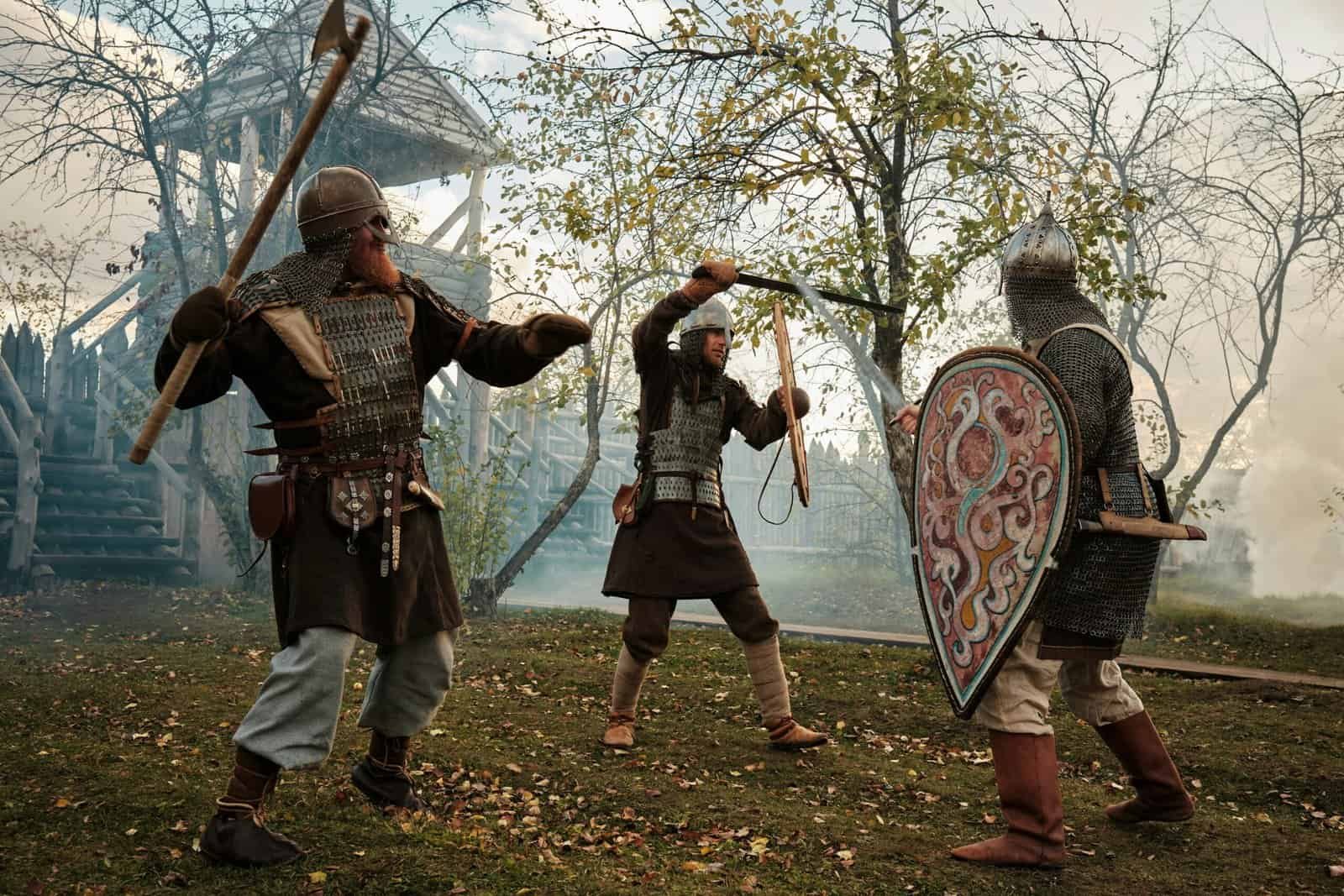
Vikings are having a moment in American pop culture — streaming shows, video games, a wave of interest in Norse history. What most fans watching don’t know is that there’s now a real combat sport built around the same imagery: full-contact armored medieval combat, fought with real steel weapons, blunted but genuinely dangerous, by teams in up to 15 kilograms of plate and mail.
Have you heard of Buhurt?
It’s called buhurt, sometimes branded HMB (Historical Medieval Battle), and it has spent the last decade growing from a niche reenactment hobby into an organized international sport with its own federations, world tournaments, and television-ready spectacle.
What the sport actually is
Buhurt strips medieval tournament combat down to a team sport: two sides, most commonly 5-versus-5, face off inside a roped or fenced arena, wearing full steel armor and wielding blunted swords, axes, and maces. The objective is simple — put every opposing fighter on the ground while staying upright yourself, or force a clean knockdown that a judge calls. There’s no scoring for style. It looks, and is often described by fighters themselves, as closer to rugby in full medieval plate than to fencing or stage combat.

Where it started, and where it’s biggest right now
Modern buhurt traces back to Eastern European reenactment culture in the mid-1990s — the earliest large-scale organized battles were staged in Izborsk, Russia, in 1996 — and the sport went properly international in 2009 with the first Battle of the Nations tournament at Khotyn Fortress in Ukraine, drawing teams from Ukraine, Russia, Poland, and Belarus under one unified rule set. Russian and Ukrainian teams dominated the sport’s early competitive era. Governance has since shifted: national federations broke away from the original Russian-led international body over control concerns, and Buhurt International (BI) is now the primary governing organization running the global calendar.
The Viking sport Buhurt is hitting strong in the UK, China and the United States
Today the strongest scenes run through the UK, mainland Europe, and increasingly China and the United States. Britain’s Castleton Cup has grown from fewer than 10 competing teams to 14 in just a few years, alongside two other major annual UK tournaments, the Tournament of Deeds and the Heritage Shield. China’s Comrade in Arms Cup, now in its sixth year, pulled its largest field yet in 2026 — nearly 70 athletes across seven teams, including two squads from Russia. In the US, regional events like North Carolina’s Carolina Carnage have become a growing entry point for a new domestic fanbase.
Boxing versus MMA: the rivalry for combat sports supremacy
How dangerous is it, really
Genuinely dangerous — this isn’t stage combat. Fighters compete in real steel armor taking real strikes from blunted but solid steel weapons, and injuries are a routine part of the sport: broken fingers and hands, concussions, torn ligaments, and dislocated joints are all common at major tournaments. The armor absorbs a large share of the force, which is why fatalities are essentially unheard of in organized competition, but “safe” is relative — this sits closer to rugby or American football on the injury spectrum than to fencing, with the added variable of live edged-and-blunt weapon contact.
Do fighters actually earn money from it?
Mostly not, not yet. Buhurt has nothing resembling the UFC’s or boxing’s prize-purse economy. National-level Buhurt League Challenger tournaments attract sponsorship packages tied to local media coverage, and top fighters can pick up equipment sponsorships and appearance fees, but there’s no equivalent of a UFC contract or a PPV purse — the sport currently runs on federation structure, ticket sales, and genuine passion rather than fighter salaries. That may be the single biggest thing separating buhurt’s growth curve from MMA’s: one is being built as a media business from day one, the other is still fundamentally an amateur sport with professional ambitions.

Where to actually watch it
Most major tournaments stream live on YouTube — Buhurt International’s own channel covers the international calendar, and individual events post full replays. Buhurt Prime, widely regarded as the sport’s most prestigious annual tournament, has run in locations including Monaco with full English-language livestream coverage. For a first watch, a Buhurt Prime or Battle of the Nations final is the best entry point: full armor, full contact, five-a-side, decided in minutes.
The Vikings and the myth attached to them
The sport rides on Viking-coded imagery, but the history it draws on is more complicated than popular culture suggests — most people assume the Viking Age belonged to Norway specifically, largely thanks to shows like History Channel’s Vikings.
In reality it was a shared Scandinavian phenomenon: Danish raiders focused on England and France, Norwegian expansion ran west into the Atlantic, and Swedish traders pushed east into Russia. Denmark, not Norway, also had the strongest political claim on the era — Norway spent roughly four centuries under the Danish crown, from the late 1300s until 1814. None of which buhurt fighters need to know to throw a good shield check, but it’s a useful correction for anyone assuming the sport’s aesthetic maps neatly onto a single country’s history.
Eight sites, one family — travel, wine, sport and sharper thinking. Explore the rest of the universe.


