
Nobody can say what caused the Pogačar crash — and no rule cycling has written would have stopped it
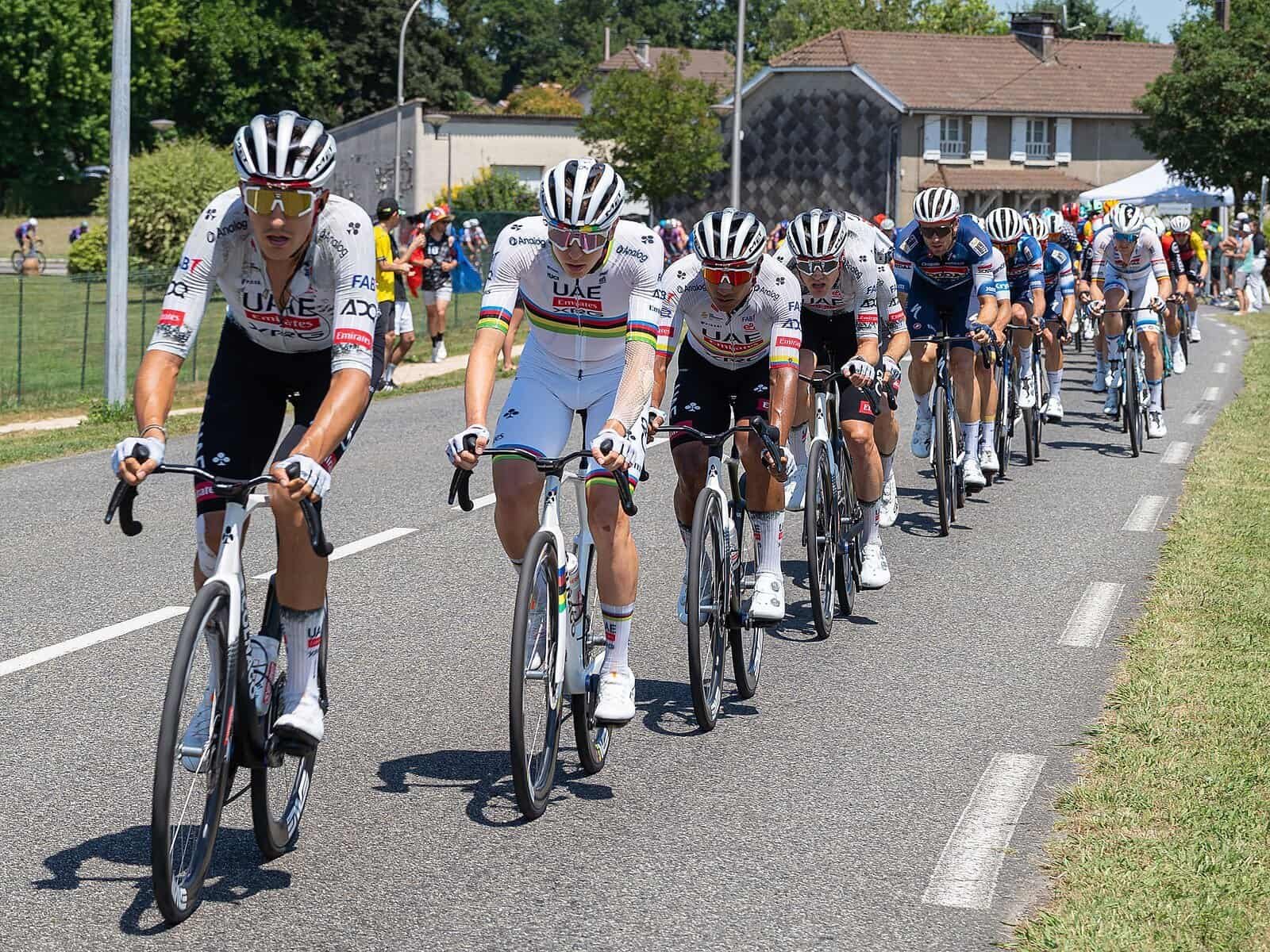
Tadej Pogačar is in a hospital bed in Barcelona with a broken collarbone, a fractured bone in his neck and a concussion. The Vuelta a España has a leader who has never worn the red jersey before in his life. Both of those sentences were written by about four seconds of stage eight, on a wide, straight road, 33 kilometres from the finish, on a day nobody had marked as dangerous.
Here is where he is medically, what it does to the race, and the question the Pogačar crash has reopened: is professional cycling actually getting more dangerous, or does it only feel that way when the danger reaches the most famous rider in the sport? That last one has data attached to it, and the data does not say what most of the reaction has assumed.
World Cycling News
How Pogačar is
The diagnosis is a concussion, a displaced fracture of the left collarbone, a stable fracture of the C7 vertebra — the lowest bone in the neck — and a set of abrasions. Stable is the word that matters in that list. It means the fracture is not going to move and the spinal cord is not at risk.
He was taken first to the hospital in Gandía, the nearest facility to the crash, then moved by ambulance to Barcelona, roughly 350 kilometres up the coast. The collarbone needs surgery and the surgery has been postponed. His team’s medical director, Adrian Rotunno, put it plainly: “He will require clavicle surgery, which will be delayed due to concussion precautions.” On Sunday morning Pogačar posted a photograph of himself from the hospital bed in a neck brace, face and hand grazed, set to the Bee Gees’ “Stayin’ Alive” — which tells you the man is fine in the way that matters most and nothing at all about when he races again.
The scale of it is easier to see in his record than in the injury list. This is the first Grand Tour he has abandoned, in his tenth start. He had never finished one lower than third. It is his first abandon of any kind since Liège–Bastogne–Liège in 2023. He had won three stages of this Vuelta and led it by 3 minutes 50 seconds, and he came here for the one Grand Tour he has never won.
Professional cycling´s one-race problem: the Tour de France, and everything else
Professional cycling’s one-race problem: the Tour de France, and everything else
Nobody can say what caused the Pogačar crash
The account that has settled into the reporting is a stone. Something rolled or sat on the road, Pogačar swerved right, made contact with a rider beside him and went down hard, and riders behind rode into the wreck and fell on top of it. Cyclingnews, having gone back through the television footage, reported that there is no definitive evidence for the stone and that a collision with another rider does not look like the thing that started it. His team called it a race situation. His sports manager, Joxean Matxin Fernández, went further: “It’s no one’s responsibility. It’s simply one of those things that happens in cycling, unfortunately.”
He is almost certainly right, and that is the uncomfortable part rather than the reassuring one. Run the elimination. This was not a bunch sprint. It was not a technical descent, a roundabout taken at the wrong angle, a badly placed barrier or a traffic island in the last kilometre. It was a wide road, in the middle of a stage, in daylight, with nothing about it that a course inspection would have flagged. Every category the sport has spent the last two years learning to regulate was absent.
Is racing getting more dangerous?
This is the question worth spending the words on, because it is the one being answered loudest and with the least evidence.
Cycling now has an incident database. The UCI recorded 497 race incidents in 2024 across the top two tiers of men’s and women’s professional racing. The analysis from SafeR, the body set up to own rider safety, found that nearly half of all WorldTour crashes happen in the last 40 kilometres of a race, clustered on the run-in to a sprint. Around 13 per cent are attributed to the tension building towards a sprint or a summit finish. Around 11 per cent to a slippery surface.
Then there is the speed argument, which is the one everybody reaches for. A review of eighteen separate studies on race speed and crash risk, led by Dylan Mordaunt at Te Herenga Waka — Victoria University of Wellington, found two things worth separating. Speed makes an injury worse once a crash has started — that part is not in doubt. But the link between speed and the likelihood of crashing is weak and depends heavily on context. And injury rates in the WorldTour have risen while average race speeds have stayed flat.
Sit with that second finding for a moment. If riders are getting hurt more often but not riding faster, then speed is not the variable that changed.
The tiredness explanation has the least behind it
The popular reading after a day like Saturday is that the riders are exhausted, the calendar is too long and the racing is too hard. It is a plausible story and there is no public dataset that supports it. Nobody has published a link between accumulated race load and crash frequency, and it is worth saying so rather than repeating it because it sounds right.
What the incident data gives instead is a location. The crashes happen where the road narrows the odds — in the last 40 kilometres, where forty riders need the same two metres of tarmac at the same moment because the finish is close enough to fight for. That is not a story about tired legs. It is a story about how much is riding on position, which is downstream of a calendar where a handful of races carry almost all the value and everything else has to justify itself. We have written before about professional cycling’s one-race problem, and this is one of the places it surfaces as physical risk rather than as a scheduling complaint.
What the sport has actually regulated
A fair amount, and almost all of it on the bicycle. From 1 January 2026 helmets must meet a minimum ventilation standard, and shells or accessories that cover the ears are banned, as are integrated and removable visors. Rim height on road races is capped at 65 millimetres. Handlebars must be at least 400 millimetres wide. Forks have maximum internal widths, 115 millimetres at the front and 145 at the rear. Bike computer screens face a size limit, justified by the UCI on the grounds of riders’ cognitive load. Behind all of it sits the second season of the yellow card system, which lets a commissaire punish dangerous riding on its own rather than only as an add-on. The governing body’s stated basis for the package is SafeR’s recommendations.
The one measure aimed squarely at speed — a maximum 54×11 gear — is paused, after legal pushback from SRAM. The researchers who reviewed the evidence are unenthusiastic about it anyway: they estimate it would take 5 to 10 km/h off a top sprint, bringing the fastest finishes from around 75 km/h down to 65 or 70, while most sprint collisions happen below peak speed and come from contact or a change of line. On a descent, where a large share of the worst injuries occur, riders are freewheeling. Gearing does nothing there at all.
What that review recommends instead is course design, standardised barriers, consistent enforcement of the rules that already exist, and shared incident data so that hazards can be found as patterns rather than as anecdotes.
Set that against stage eight and the awkward conclusion is unavoidable. Not one item on the 2026 list would have changed anything that happened at 33 kilometres to go. A helmet ventilation standard, a rim depth, a handlebar width and a computer screen do not address an object lying on a road surface. The reason equipment gets regulated first is not that it is the biggest risk. It is that a bicycle can be measured at sign-on by one commissaire with a gauge, and 3,300 kilometres of Spanish road cannot.
What happens to the race now after the Pogačar crash?
It became a different race within a day, and a better one as a contest. Enric Mas inherited the red jersey when Pogačar climbed off, then went out on Sunday and earned it, attacking three kilometres from the summit of the Alto de Aitana with Oscar Onley on his wheel and riding away to the stage win. It is the first time in his career he has led a Grand Tour, after years of finishing near the front of races decided by other people.
Behind him after nine stages: Primož Roglič at 1:18, Felix Gall at 1:39, Onley at 2:20, Richard Carapaz at 3:26, Mattias Skjelmose at 3:55, Sepp Kuss at 4:09. Twelve stages remain, including the second time trial and the summit finishes this route was built around, and a minute and a bit covers the top two. That is a genuine three-week fight, which the race had stopped being while Pogačar was in it.

The extraordinary detail of the Pogačar crash.
Tadej Pogacar riding surrounded by other riders inside the pelotonis who is not in that list. Jonas Vingegaard, who won this race in 2025, broke his collarbone on stage 15 of this year’s Tour and will not race again in 2026. Pogačar broke the same bone seven weeks later. The two riders who have carried Grand Tour racing between them — the small-country revolution of Slovenia and Denmark that has decided most of the last six years — are both out of the same race, with the same injury, in the same season. Roglič, the third of that group, went down himself in the opening kilometres of stage eight and got back up.
And it is the Vuelta’s second consecutive edition in which the defining events were not the racing. In 2025 the finale in Madrid was cancelled for the first time in the race’s history after pro-Palestinian protests occupied the route. In 2026 stage three was lost to weather before the race reached Spain, and stage eight took the leader.
When this race started in Monaco we wrote that the Vuelta had made unpredictability its competitive advantage and built a route to guarantee it. It did not need the route. The sport got its open race and its best rider in a neck brace out of the same four seconds, and the four seconds had nothing to do with the design. Cycling has spent two years making the bicycles safer, and the bicycles were not the problem on Saturday. The road is the part nobody has paid for yet.
Verification note for the Pogačar crash. Injuries, hospital transfer and the delayed surgery are as stated by UAE Team Emirates medical director Adrian Rotunno, 29–30 August 2026. The cause of the crash is not established: the stone is the most widely reported account and no source we found treats it as confirmed, so it is given here as the account rather than the fact. Classification positions and gaps are after stage nine, 30 August. The 2026 equipment rules, the yellow card system and the SafeR incident figures are from the UCI’s own published material; the 54×11 gear cap is paused, not in force. The speed and crash-risk findings are from the review led by Dylan Mordaunt, Te Herenga Waka — Victoria University of Wellington. Figures circulating that claim crash or injury increases of 300 to 400 per cent over the past decade are not printed here: we could not trace them to a primary source. Race distance is given elsewhere on this site as approximately 3,300 kilometres because published totals disagree; the same caution applies.
Eight sites, one family — travel, wine, sport and sharper thinking. Explore the rest of the universe.


