
Nobody taught them to slide on a hard court
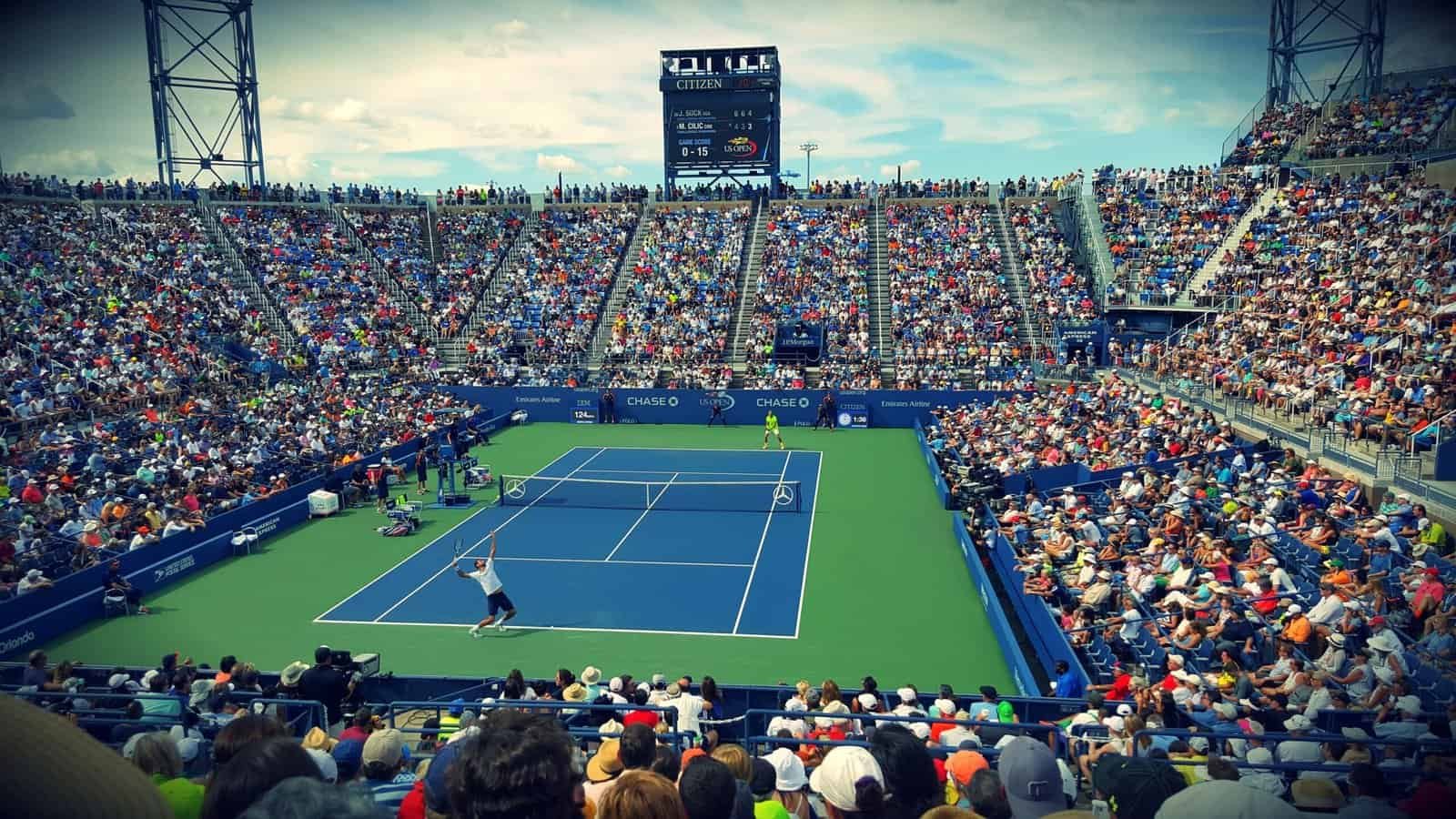
Watch the next time a rally at Flushing Meadows goes wide to a forehand. The player will not run, stop, plant and hit. They will arrive at the ball already sliding — both feet skating across acrylic paint laid over asphalt — and they will strike it in the middle of the slide, outside leg loaded like a brake. Then they will push out of the skid and be back near the centre of the court before the ball has recrossed the net.
Twenty years ago almost nobody did that. The handful who did it did it by accident, on one wing, as a last resort. Nobody taught it. There was no coaching manual, no federation programme, no biomechanist who worked it out and handed it down. A generation of players simply started doing something on a surface that was specifically engineered to stop them doing it, and by the time anyone thought to measure why it worked, it had already become the way the game moves.
The surface was built to grip
A hard court is not a neutral floor. It is a manufactured product with a specification. Under the paint is asphalt or concrete; the paint itself is acrylic resin loaded with silica sand, and the amount of sand in the mix is the dial that sets how fast the court plays and how hard it holds a shoe.
In 2020 the US Open changed suppliers for the first time in more than four decades, moving from DecoTurf to Laykold. The tournament’s courts sit at a Court Pace Rating of roughly 43. The International Tennis Federation sorts surfaces into five bands by that number — slow, medium-slow, medium, medium-fast, fast — and 43 puts New York in the medium-fast band: quick, but some way short of the slickest indoor courts.
That is the pace. Grip is the other half, and it is the half that matters here. Laboratory work comparing surfaces has found that the coefficient of friction on clay — both translational, the sliding kind, and rotational, the twisting kind — is lower than on a hard court, and that the peak loading rate is higher on hard. In plain terms: clay is designed to let a shoe go, and a hard court is designed to hold it. Everything a player does on one is meant to be impossible on the other.
The slide was discovered, not invented
Sliding into a shot on a hard court, as a routine part of movement rather than a stunt, is roughly fifteen to twenty years old. It has ancestors. Michael Chang and Paradorn Srichaphan drew gasps doing it before most people thought it was possible — but they did it far less often, almost exclusively on the forehand side, and usually as an attempted finishing shot on the dead run. It was what you did when you had already lost the point and had nothing to lose by trying.
What changed is not the frequency but the purpose. The modern slide is a recovery mechanism. A player slides not to reach a ball they were never going to reach, but because stopping via a controlled skid is faster than stopping via a series of decelerating steps, and because the skid can be aimed — you come out of it already pointing where you need to go. It happens on both wings, dozens of times a match, and it is now so normal that its absence is what looks strange.
This is worth sitting with, because it is rare. Most changes in elite sport are introduced: a coach has an idea, it wins something, it spreads. This one arrived from underneath. The game got fast enough and the baseline exchanges heavy enough that conventional footwork stopped being able to keep up, and players found the answer with their feet before anybody described it in words.
The physics is not what you would guess
The obvious explanation — that shoes got slippier, or courts got smoother — is wrong. The real answer is stranger, and it was worked out by engineers rather than coaches.
James Clarke and colleagues at the University of Sheffield and the University of Exeter, working with the International Tennis Federation, built a pneumatic rig to reproduce the moment a shoe meets a court and ran it at varying speeds. What they found is that friction on a hard court is not a fixed property at all. As the relative speed between the shoe and the surface rises, the rubber behaves differently — it stiffens, the real contact area between sole and paint drops, and the traction force falls away with it.
Which means grip depends on how fast the shoe is already travelling across the ground. A player who arrives slowly gets a court that holds them. A player who arrives fast enough, and meets the surface at the right contact angle, gets a court that lets go. Clarke’s group concluded that under those conditions, sliding on a hard court works in much the same way as it does on clay.
Read that again, because it inverts the usual picture. The surface does not change. The player changes what the surface is, several times a game, by controlling the speed and angle at which they hit it. The slide is not a trick performed despite the court. It is a negotiation with the court’s own physics, conducted at a fraction of a second’s notice, thousands of times a fortnight.
The practical consequence is that grip became a thing worth measuring properly. Matt Carré and Daniel Ura, also at Sheffield’s department of mechanical engineering, developed a handheld device for the ITF to take friction readings on court — because if traction is variable, and if it decides how a match is played, then somebody has to be able to check it at the venue rather than infer it from the specification sheet.
What everyone believes about hard courts and injuries is half wrong
Here is the received wisdom, repeated every August: hard courts wreck bodies, the summer swing is a meat grinder, and the surface is shortening careers.
The evidence does not support it as stated. A systematic review of injury incidence across playing surfaces found no discernible difference in total injury rates between clay, hard and grass. If the hard court were the destroyer of the popular account, that is not what the aggregate numbers would look like.
But the same body of work finds something more interesting: while the totals hold roughly level, the kind of injury shifts with the surface. Hard courts carry a higher rate of lower-limb overuse injury, which lines up precisely with that higher peak loading rate. Clay, with its lower friction, spares the joints and asks for the fatigue instead — longer rallies, more of them.
So the surface does not break you in a moment. It bills you monthly. The damage is cumulative rather than acute, which is why the popular belief feels true to anyone who has watched a career play out and yet fails to show up in a table of injury counts. “Hard courts end careers” is wrong as a sentence and roughly right as an instinct, and the gap between those two things is the whole story.
The people closest to it are blunt about the loads involved. Doug Eng, a coach who has served on the United States Tennis Association’s sport science committee, puts it simply: the forces on the body are much greater on hard courts. Alex Kor, a podiatrist and a nationally ranked senior player, is blunter still about amateurs copying what they see on television — unless you are genuinely adept at it, he warns, the slide ends in a sprained or fractured ankle.
Which brings the thing full circle. The professionals do it thousands of times a season and mostly walk away intact. That is not because it is safe. It is because they are that good at it.
Why the fortnight is the test, not the match
Chronic loading is the reason the US Open selects for something slightly different from the best tennis player. There are 128 players in each singles draw, which means seven match wins for the title, best of five sets for the men, in New York air that does not cool down until September.
The tournament now runs 22 days end to end — Fan Week from 23 August, the main draw from 30 August, the men’s final on 13 September. The main draw was stretched across 15 days precisely so the early rounds have more room in them, which is an admission by the sport itself that accumulated load, not any single afternoon, is what takes players out.
This is what makes hard-court tennis a different examination from the other two surfaces. Roland-Garros asks whether you can suffer for four hours and come back and do it again. Wimbledon asks whether you can hold your nerve on a surface that gives you no second chances. New York asks whether the structure you have built out of tendons and cartilage over ten months of a season that is mostly played on this stuff has anything left in it on the second Sunday.
Seven wins. Nobody has ever made that easier by playing well early.
What to watch for, now that you know
Once you can see the slide as a decision rather than a flourish, the match reads differently. Watch who slides on the backhand side as readily as the forehand — that is the harder one, and it separates the complete movers from the merely fast. Watch what happens to a player’s willingness to slide in the fourth set, because the technique costs something to execute and fatigue shows up there before it shows up in the groundstrokes. And watch the players who barely slide at all, and win anyway, because they have solved the same problem a different way.
None of this makes it less impressive. That is the test we hold every piece on this site to, and the slide passes it easily. A player is running at close to full speed toward a ball that is going away from them, on a surface engineered to hold their shoe in place, and they are exploiting a property of rubber under shear that a laboratory needed a pneumatic rig to characterise — arriving at exactly the velocity and angle that turns concrete into clay for about a third of a second, hitting a tennis ball in the middle of it, and getting back before the reply lands.
Nobody taught them that. They found it. And from 30 August, for two weeks, they will do it a few thousand times on a court that was built to make it impossible.
What else has changed about the tournament this year — Fan Week, the rebuilt mixed doubles event and the stretched main draw — is covered in our US Open 2026 curtain-raiser.
More on the sport at our tennis section, and every major date in world sport on the World Sport Calendar.
Eight sites, one family — travel, wine, sport and sharper thinking. Explore the rest of the universe.


